India eliminated all juries in 1955. The criminal lawyer who told me this, a senior advocate by title and a man with two Mont Blanc pens in his pocket, explained that it was preferable to have judges decide cases where it was necessary to apply a statute, because non-lawyers would never be able to understand written laws. He asserted that in my country we apply the common law, which was appropriate for the common man to apply, and therefore US juries make sense. I was so open-mouthed, I didn't correct him.
He also is very proud of the Indian Penal Code, a slim volume (he gave me a copy) not much changed from when it was written in 1860 by Lord Macaulay, who Mr. Lawyer Sir admires. Apparently he is unaware of Lord Macaulay's disdain for India and Indians: Macaulay wrote that the entire body of Indian literature and philosophy was not worth a single bookshelf of western writing. (Churchill, who was stationed here in the 1890's, said India was "a beastly country with a beastly religion", and "no more a country than the equator".)
The average length of time to resolve a case in court is about 20 years. The oldest pending case, not yet gone to trial, is 60 years old; the next oldest is 50 years. My host family's 19 year old son was run over when he was 4 and unconscious for 3 days. The case is still pending; their lawyer says "What's your hurry, we'll get money in 10 years, for his wedding." I told them to insist he take the case to mediation, and the big revelation for them was when I said "He's your servant; you're the master. Insist." Premie, the mom, said "Really?? With this knowledge, now I can talk to him without being afraid. This is such a new idea!" I said that if the case is resolved while I'm in India, I will have achieved something amazing.


Go See My Photo Blog

Go to www.RCOBO2.blogspot.com for a good look at lots of photos. (This is the taxi stand by my office)
Railway Sign

Elephant Statue

Elephants all over
Designs on the Floor

Everywhere I go there are these lovely symbols painted on the floor, which have a name I don't know. See more at my photo blog.
Restaurant Food

All you can eat for 30 cents, on a banana leaf, delicious!
Gifting Justice Akbar Ali
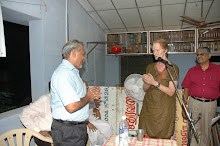
Almost at the end of the long ceremony inaugurating the Mediation Centre, where my job was to give the gift to the Justice
Me and Justice Akbar Ali
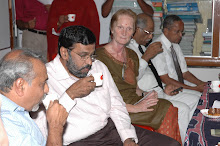
Justice AAli at left, Dr. Vincent, psychiatrist, me with bindi, (forehead spot - third eye) 2 other important judges, having sweet tea and cake during ceremonies inaugurating our Mediation & Counselling Centre


No comments:
Post a Comment